Articles | Back to list page
13 Fun and effective goal setting activities for your child
| ID | 1643 |
|---|---|
| Title | 13 Fun and effective goal setting activities for your child |
| Published | True |
| Body |
In our quest to see our children succeed in life, we give prominence to the “big things”: a good education, nutritious food and a loving home environment. But too often, we forget about teaching them one skill that is essential for success: how to set goals. Goal-setting also helps children academically. Studies show a significant positive correlation between goal-setting and student achievement. It’s no wonder then, that goal-setting helps establish a lifelong habit for success. But here’s the thing: goal-setting doesn’t come naturally to children. It’s up to you, parents, to teach your children this important life skill. Goals work best when they are specific, realistic, and time-bound: give your children the freedom to choose their own dreams, and provide a reality check about the challenges that may lie ahead. Teach your children that it’s okay to smart small, and that little goals can lead up to bigger ones. And always applaud their effort, even when they fail. The good news is, goal-setting doesn’t have to be a boring task! Here are some fun goal setting games that will get you and your child started. 1. Organise toys. Goal-setting can be established even at a young age. A really fun game is to encourage your toddler to arrange blocks by colour, or complete a “stacking ring toy” by him/herself. With an older toddler, set a timeframe: “When the big hand of this clock comes to six, build the tallest tower in the world!” This instills in the child a certain level of confidence in his/her abilities and teaches him/her to accomplish a task within a set time. Celebrate each success by praising your child! 2. Overcome playground fears: Toddlers love playgrounds, but often have to overcome their own little fears to “conquer” play equipment. For example, your little one might really want to play on the slide, but is scared to do so. Use such instances as opportunities for problem-solving and goal-setting: “First, you’ve got to climb up the ladder, one step at a time. Next, sit at the top of the slide, and come down. It’s so much fun, and Mummy will be right here to catch you!” Here, you’re teaching your child how to problem-solve only by guiding him/her. But your child has to solve the problem alone (overcoming fear) to achieve his/her goal (having fun on the slide). The more kids do things on their own, the more they’ll develop self-confidence and build thinking skills. Overcome playground fears 1
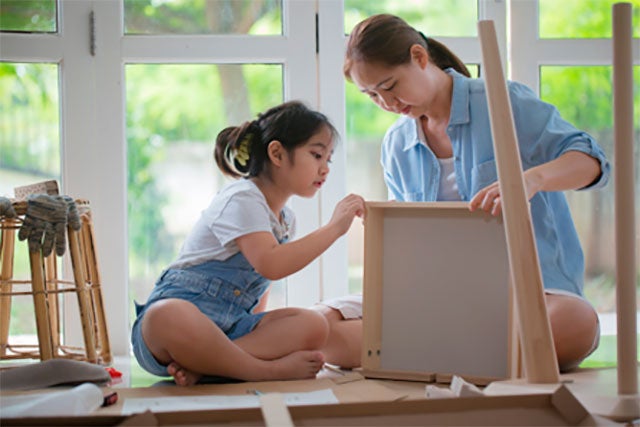
4. Put the pieces together. Get on the floor with your toddler and break out those simple puzzles! Working with puzzles helps children see how small goals (laying down the edges first, or sorting the pieces by colour, then piecing them together) ultimately lead to the successful achievement of a larger goal (a completed jigsaw puzzle). Put the pieces together 1
For Preschoolers (ages 3-5): 6. Make a family bucket list. Knowing they’re not alone in making—and achieving!—goals can further motivate your child. Get the family together and brainstorm over a “bucket list” of experiences, goals, and dreams. Set out tasks that each member can do to achieve these goals. At the end of the year, look back at what the family has accomplished. This is a great time to discuss the difference between short-term and long-term goals, and what the family can do as a unit to meet them. 7. List “3 Stars and a Wish.” Ask your preschooler three things he/she is proud of—it could be that he/she is a great friend, can count up to 20, or can spell his/her name. Then ask your little one what he/she “wishes” to be able to do. Could it be to tie his/her shoelaces alone, or sing the national anthem? List these down and discuss the steps to how to make these wishes a “reality.” Create a new list every week, making sure to highlight your child’s achievements and “stars.” Reward your little one with stickers or his/her favorite treat with every “wish” granted! 8. Let every action matter. Goal-setting teaches kids to take responsibility for their actions. After all, their choices in solving problems are what bring them closer—or further—from their goal. Have them fill out a “My Actions Have an Impact” worksheet: list down an action (“I will listen to my teacher”), then write the positive and negative outcome from it. This will encourage kids to intentionally choose “good actions” in the future! 9. Make an “If I could learn anything” vision board. Get scissors and glue, and print out the activity—or activities!—your child would like to learn. Stick it on an illustration board, and have your little one decorate it with stickers and more cut-outs. Then, list down the things he/she could do to achieve that goal. Encourage your child to think outside the box: just because everyone else plays football doesn’t mean your child needs to dream about being the next Ronaldo as well. Ask your child to think about certain activities he/she has always wanted to do, but never thought was able to. It’s called “if I could learn anything” for a reason! 10. Create a goal ladder. Does your five-year-old kid have dreams of being the next Serena Williams or Mark Zuckerberg? Then a goal ladder just might help your little one achieve that. Draw a ladder and list the biggest goal at the top. Then list the different “steps” your child will need to do (e.g. show up for practises, eat healthy meals) to make the dream a reality. This activity is great for long-term goals, so your child sees the smaller goals he/she has to achieve in order to get the top prize! 11. Complete the wheel. Create a “wheel of goals” by drawing a big circle and dividing it into segments, like a pizza. List down important categories in each “slice,” such as “home, school, family,” etc. Brainstorm with your primary-schooler about what goals he/she would like to achieve in each category (e.g. “clean my room,” “write in cursive,” “train the dog how to ‘sit’”) Discuss how your child can achieve each goal. 12. Bring out the Chore Chart. Chore charts—which list each family member’s chores for the week—is a simple yet no-brainer example of goal-setting. In order to get rewarded with something special, family members need to complete certain tasks at home. Make it fun for the little ones by incorporating stickers, treats, or trips to their favourite restaurant. 13. Share your own goals. Remember: your children are greatly influenced by your actions, so seeing that you have goals of your own helps them keep working to meet theirs. Make a lunch date and share your personal goals, the steps you’re taking, and even the times that you’ve struggled to meet them. Doing so also teaches your kids the importance of perseverance, and can teach them a thing or two when it comes to strategising.
|
| Image |
https://www.wyethnutrition.co.id/sites/default/files/2023-02/3_fun_and_effective_goal_setting_activities_for_your_child.jpg
|
| PWA Dimensions | self_control |
| PWA Experts | |
| PWA Tags | Indoor |
| PWA Lead | Too often, we forget about teaching them one skill that is essential for success: how to set goals. |
| PWA Slug | /13-fun-and-effective-goal-setting-activities-for-your-child |
| PWA Waiting for Review | True |